0

The Secret to Building Your Marriage God’s Way

Jesus likened our Christian walk to building a house. In this article we will use the analogy of building a house to contrast two secular views of marriage with the biblical view. We will compare the characteristics and values of the Traditional African Secular Model and the Modern Western Secular Model with the Biblical Model of marriage.

Regardless of cultural background, everyone who attempts to build their marriage on a foundation other than what God has established, Jesus said is comparable to being a foolish man who built his house on the sand (Matt. 7:26).

The Wise and Foolish Builders

The Wise and Foolish Builders

Therefore everyone who hears these words of mine and puts them into practice is like a wise man who built his house on the rock.  The rain came down, the streams rose, and the winds blew and beat against that house, yet it did not fall, because it had its foundation on the rock.  But everyone who hears these words of mine and does not put them into practice is like a foolish man who built his house on sand.  The rain came down, the streams rose, and the winds blew and beat against that house, and it fell with a great crash (Mat. 7:24 – 27 NIV).

 MARRIAGE AND CULTURE

Marriage was established by God as a covenant relationship between Himself, a man and a woman.  Though it was established by God, marriage must be lived out in a cultural context.  The idea of marriage originates from God and He therefore has established specific principles on how it should be built.  The Bible provides the framework and establishes principles that can be applied to any culture.

 PREPARING TO BUILD

When someone decides to build a house, important decisions need to be made. First, an architect will be chosen to draft the blueprint and then the builder will enter into a legal agreement by signing a contract.

According to the African Traditional Secular Model, the architect is the god of this world (John 14:30), and the blueprint is their culture. In this marriage, the couple conforms to their cultural values and follows traditions passed down for generations.  Their house closely resembles all the other houses in their community.  In this marriage, the builder is the husband and his wife is his helper.

The only difference between the Modern Western Secular Marriage and the African Traditional Secular Marriage is that the husband and wife will tend to be more egalitarian in their approach. They too enter the marriage with their own ideas of what the house should look like and how it should be constructed. Both of these models for marriage conform to the values of their cultural context which are influenced by the ruler of this world.

ContractThe Contract

In both of these secular models, the legal agreement is a contract between two people that can be broken or nullified at any time—that is, if they are unsatisfied with the way the “house” turns out or if either of them decides to build a better house with someone else.
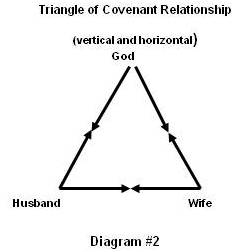
Slide2According to the Biblical Model, God is the Architect. The Christian couple who chooses to build a biblical marriage will diligently follow God’s Word as their blueprint. The husband and wife are the builders—equal partners—in the building process. Rather than entering into a legal contract between two people, they enter into a covenant with each other and God forming a “Triangle of Covenant Relationship” (Diagram #2), which is both a vertical and horizontal relationship.

Derek Prince, in his book The Marriage Covenant, described the relationship as follows:  

“…marriage as it was conceived at creation, is a binding together of three persons: a man, a woman and God.  When God is added to the relationship, it introduces a new dimension. God becomes an integral part of the marriage” (1978, 24).

Slide3AUTHORITY IN MARRIAGE

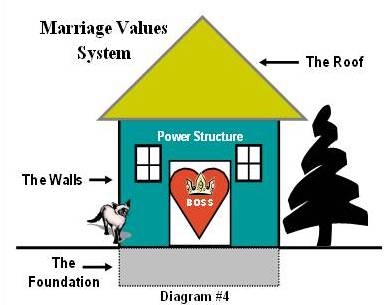
Once the house is ready for occupancy, the couple will have to make an important decision: Who will be “in charge” in their marriage? In other words, who will be given the place of “authority”? They only have two options: the boss will either be “God” or “Self” (Diagram #3).

My PlanIf the husband and wife place their own interests, desires and needs first, then “Self” will be enthroned as the authority in each of their hearts.  Their marriage will quickly become a battlefield where two selfish people lock horns in a battle of the wills. When the storms of life shake such a marriage, the superficial love that initially brought them together usually dwindles and may die completely.

CoContractorsIf they choose to obey Christ’s commandment to love and serve one another (Gal. 5:13-26; Phil. 2:1-5) and give up their right to control the other, they have placed God in the position of authority in the marriage. Marriage cannot be understood apart from our obedience to Christ’s command to do nothing out of selfishness but with humility of mind put another person’s interests ahead of our own.

Jeffrey and Pattiejean Brown in their book, The Total Marriage, in the section entitled “It Takes Two to Submit” describe how authority operates within a biblical marriage:

I believe that when people of the world look at a Christian home they have a right to see something different.  A man and a woman not striving to be the boss.  Instead, they’re striving to outdo one another in love.  Nobody imposes his or her will on the other anymore.  Nobody gives in just for the sake of peace.  They seek God together.  They develop together.  They grow together.  Christian marriage has been defined as a union of loving service to others (1999, 56-58).

POWER STRUCTURE IN MARRIAGE

Finally, the couple will have to determine what their roles and responsibilities will be in the marriage.  This is what we call the power structure. In his video series, Building Families that Last, Dr. Richard Dobbins explained the importance of couples determining their power structure in marriage:

Role conflict and power struggles are some of the most threatening problems facing couples in marriage.  Christians are not immune from the role changes that are taking place in our society today.  Very few couples have the foresight to discuss the power structure of their relationship before they marry.  What role and responsibilities will the husband fulfill in the marriage and family?  And what will the wife’s role and responsibilities include? Mutually determining the power structure of the marriage will eliminate much lost and wasted energy in competing for leadership later on.  The couple needs to agree on the power structure of their relationship, for families that achieve purpose are built on powerful marriages.

Power Structure Models

In Her book, To Have and to Hold, Nancy Van Pelt described five different role models in marriage: Patriarchal, Matriarchal, Co-leadership, Power Struggle, and Supportive Leadership.  Van Pelt used the term Role Patterns, which is what Dobbins referred to as power structure. We will look at three of these models as they apply to the models being discussed in this reading:

Patriarchal. The model of choice for the Traditional African Secular marriage: “Husbands rule and wives obey!” is the motto of this marriage.

In this relationship the husband’s leadership is unquestioned.  His word is law.  He determines all policies and rules for the entire family.  The patriarchal leader may or may not choose to consult with family members, depending upon his degree of authoritarianism (1980, 120).

Power Struggle. This is the popular model for the Modern Western Secular marriage; “Every man for himself!” and “May the best man win!” describe this marriage.

In this pattern both husband and wife compete for the leadership role.  He fights against her when she attempts to make a decision, and she counters with methods of usurping his authority.  The contestants have never clarified their rules, and authority in the family shifts from one partner to the other, depending on who wins the last battle (1980, 120).

Supportive Leadership. The Supportive Leadership Model is what makes the Biblical Model of marriage so unique and different from all the rest and gives marriage the power to withstand the storms of life. The motto for the biblical marriage is “I no longer live for myself, I live for you.”

It is based on the Christian concept of mutual submission as a way of life in all interpersonal relationships.  In a supportive relationship both partners willingly give up absolute power to dictate and control.  Neither demands that his or her way is the only way and insists on unquestioned obedience.  Rather, each shows a readiness to negotiate and adjust differences until common ground is established (1980, 122).

Jeffrey and Pattijean Brown in the section entitled, “It Takes Two to Submit,” also gave their definition of mutual submission, which Paul wrote about in Ephesians 5:21.

This is what it says: ‘Submitting yourselves one to another in the fear of God’ (Eph. 5:21).  Paul is stressing the idea of mutual submission.  Mutual submission requires that Christians, regardless of status, function, sex, or rank, ‘through love be servants [literally “slaves”] of one another’ (Gal. 5:13).  If a partner is to submit as Christ’s Church is to submit, then the biblical definition of submission is a free response and uncoerced surrender to the self-sacrificing, unconditional love of a compassionate mate and committed spouse. Mutual submission is Christian and it’s a beautiful thing (1999, 56).
Slide4BUILDING A HOUSE

A good builder always begins with a solid foundation, followed by the construction of the walls, and then the roof.  In this article we will show how all of these aspects of building a house apply to building a marriage (Diagram #4).


Traditional African Secular Model
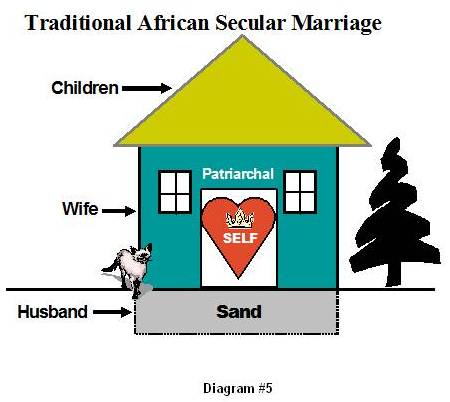
Slide5The Foundation. According to this model, the husband is the foundation making him the most important part of the structure and upon which everything else is built.  The marriage finds its origin, strength and purpose through the husband (Diagram #5).

The Walls. The wife’s place in the marriage can be compared to the walls of the house.  Her role is to hold the family together through serving her husband and children and making their lives comfortable and happy.  Her main purpose is to bear children for her husband (which also includes his clan /extended family)—they are his progeny, or his on-going spirit.  She is to serve him and obey him in every way to establish his happiness and fulfill his purpose in life.

The Roof.  In this model the children are as important to the marriage as the roof is to the house.  This illustrates the importance placed on children in the traditional marriage.  In other words, a house without children would be as foolish or useless as a house without a roof.

Modern Western Secular Model
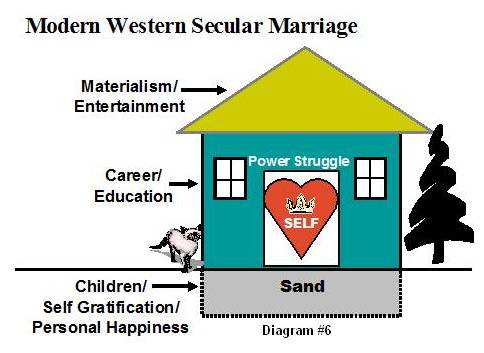
Slide6The Foundation. As illustrated in Diagram #6, according to this model, self-gratification and personal happiness rise to the top of the list of expectations for marriage.  Many people think that getting married will be their answer to personal happiness!  Too often however, within months, if not days, of saying “I do,” the husband and wife become disillusioned with the marriage when their spouse fails to meet all their needs and make them “happy.”  In some marriages children become the foundation when the couple attempts to find their fulfillment and purpose through their children.

The Walls. In this model, the couple’s emphasis on education, career and success are like the walls of a house.  If the marriage is being sustained by these materialistic values, then failure to achieve these goals will put a strain on the relationship.  If getting ahead in this world is their primary objective, such success-driven couples will become disillusioned with marriage when these objectives are not achieved.

The Roof. According to the Modern Western Secular Model of marriage, materialism and entertainment are like the roof, which is the most prominent part of the house.  Couples place a great amount of emphasis on their material possessions and “toys”—houses, cars, computers, clothes, jewelry, etc.  These “things” become symbols of marital success and prosperity.  The entertainment industry has capitalized on the modern-day trend and drive for fun and enjoyment.  Many couples will go into financial debt in order to enjoy superficial and materialistic pleasures, which places an additional strain on an already shaky foundation.

“The winds blew and beat against that house!” (Matt. 7: 27)

Slide7What happens to a marriage that is built on sand when it is subjected to the storms and problems of life?  Problems with in-laws and extended families, with children, illness, financial struggles, the death of a loved one, loss of employment, barrenness, couples who have problems with their sexual relationship and sadly, even unfaithfulness, just to name a few? These things ultimately take all the joy and fulfillment out of the marriage that is built upon any foundation other than the principles of God’s Word.  Any other approach to marriage is like building a house upon “sand” and when it falls, it makes a “great crash!” (Diagram #7)

The Biblical Model

The Foundation. The foundation of a Christian marriage is the solid Rock of God’s Word.  Everything a couple needs to know about building a successful biblical marriage is summarized in Genesis 2:24, 25: “Therefore shall a man leave his father and his mother, and shall cleave to his wife: and they shall become one flesh.  And the husband and wife were both naked and were not ashamed.”  In his book, Strike the Original Match, Charles Swindoll wrote that this scripture passage establishes the biblical foundation for marriage. He outlined four foundational principles that are necessary for building upon the Rock: leaving (severance); cleaving (permanence); becoming one flesh (unity); being naked and not ashamed (intimacy).

            Foundational Principle of Severance. The first thing God said to the man and woman when he pronounced them man and wife was that the man must “leave” his father and mother, which Swindoll refers to as the foundational principle of severance:

In order for the new relationship between bride and groom to flourish and their home to begin correctly, the cord must be cut with the parents.  This does not mean abandoning our parents or ignoring or mistreating or cutting off all contact with them.  To “leave father and mother” means to break the parent-child bond, to sever the tight, emotionally dependent strings that once provided security, protection, financial assistance, and physical needs.  All or any of those ties, if brought over into a marriage, will hinder the bond of marriage from sealing” (1981, 29).

In his book, I Married You, Walter Trobisch said this about “leaving”:

There can be no marriage without leaving.  The word “leaving” indicates that a public and legal act has to take place in order to make marriage a marriage…If no real leaving takes place, the marriage will be in trouble.  If the young couple have no chance to start their own home, completely separate from their families, the danger is great that the in-laws will interfere continuously (1971, 12-13).

            Foundational Principle of Permanence. The second foundational principle outlined in Genesis 2: 24, 25 is “cleave.”  This word in Hebrew literally means to be “glued together.”  Swindoll calls this the foundational principle of permanence:

In order for a marriage to survive…each couple needs to view the commitment to each other as an irrevocable, permanent bond…Leave and cleave. Sever and bond.  Loosen and secure.  Depart from and attach to.  The Hebrew term translated “cleave” means “to glue, to cling.”  Today’s problem is largely explained by the fact that couples enter marriage believing it is terminable.  “Till death do us part” is, unfortunately, a mere verbal formality to many who utter those words (1981, 30).

Trobisch expanded the meaning of “cleave” to include “love:”

Perhaps we would use another word today in place of “to cleave.”  We would no doubt use the word “to love.”… Cleaving means love, but love of a special kind.  It is love which has made a decision and which is no longer a groping and seeking love.  Love which cleaves is mature love, love which has decided to remain faithful—faithful to one person—and to share with this one person one’s whole life (1971, 16-17).

            Foundational Principle of Unity. Charles Swindol refers to “one flesh” as the foundational principle of unity:

Becoming one flesh suggests a process, not an instant fact.  Two people with different backgrounds, temperaments, habits, scars, feelings, parents, educational pursuits, gifts, and interests don’t immediately leave a wedding ceremony in perfect unity.  It is a lifelong project requiring wisdom, understanding, and knowledge…The whole idea of mutual acceptance, giving, listening, forgiving, belonging, and direction was implied.  It is two individuals willingly blending into each other’s lives, desiring to share with and thereby complete the other… “One Flesh” also has to do with the physical aspect of marriage.  The sexual aspect of marriage is essential to the marriage as much as the leaving and cleaving.  The success of the sexual relationship between husband and wife is directly proportionate to the success of the other areas of intimacy in marriage—emotional, spiritual, intellectual, and social (1981, 31-32).
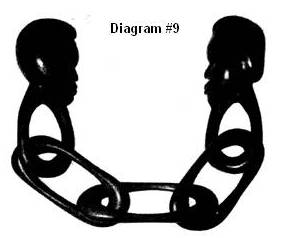
Slide9Trobisch used a wooden carving to illustrate the concept of “one flesh” (Diagram #9):

This expression describes the physical aspect of marriage…The physical union of husband and wife is as dear and as near to God as is their faithfulness and the legality of their marriage…I reached down into my briefcase and brought out a carving of two heads—the one of a man and the other of a woman.  The heads were connected by a chain with wooden links…This is a marriage symbol which the church in Liberia gives to the young couple as a reminder of their marriage vows.  If you came close and inspected it carefully, you would see that this chain has no joint. The whole piece of art is carved out of one piece of wood and conveys the message: “Where God joins, there is no joint” (1971, 17-19).

            Foundational Principle of Intimacy. Genesis 2:25 says, “And the man and his wife were both naked and were not ashamed.” Swindoll refers to “naked and not ashamed” as the foundational principle of intimacy:

The Hebrew term translated “naked” suggests the idea “laid bare,” emphasizing totally and completely naked.  When the verse adds that Adam and Eve “were not ashamed,” the idea from the original construction is reciprocal…they had no hidden areas, no hang-ups, no embarrassment, no fears.  There was total transparency, the complete absence of self-consciousness. This gave them unrestrained freedom. Emotionally as well as physically.  Inwardly and outwardly (1991, 33-34).

South African author, Costa Mitchell, in his book, Intimacy in Marriage said this:

God intended intimacy to characterize marriage. The verb “to know” is used in the Bible to describe the sexual consummation of this relationship. Genesis 4:1 “Adam knew Eve his wife, and she conceived…”Intimacy is not just sexual consummation. It encompasses a totality of knowing that includes understanding how my partner thinks, and sharing the dreams and goals she is pursuing, her values and feelings, what makes her happy or sad, feel loved and valued. Most importantly, intimacy is manifested when I cooperate with my partner, sharing her ambitions and fostering the sense that she is cherished and held in high regard. Sexual union that reflects this emotional and psychological oneness is the true intimacy God designed for marriage (1990, 21, 22).

The Walls. A house is only as strong as the walls that support it.  Swindoll also said, “God says we need only three essential ingredients to restore our marriage and make it flourish again” (1981, 24).  These ingredients are found in Proverbs 24:3, 4 which says: “By wisdom a house is built, and by understanding it is established; and by knowledge the rooms are filled with all precious and pleasant riches.”  Wisdom, understanding and knowledge are the three vital ingredients needed to construct the walls of the “house”. In order to build a strong marriage, we must use these quality materials:

            Knowledge. Couples need to acquire knowledge in order to build their house God’s way.  First, they must seek knowledge of God’s Word which teaches His view of marriage.  In the same way that a builder studies the blueprint for the house he is building, couples need to consult God’s blueprint for marriage.  Only a foolish builder would attempt to build a house without studying the plans thoroughly and referring to them continuously during the process.  Hosea 4:6 says, “My people are destroyed for lack of knowledge.”  How often we attempt to build our marriages without this vital knowledge and then wonder why they are falling apart.  A lack of knowledge can destroy a marriage, but the abundance of knowledge fills the house with precious riches.

Secondly, husbands and wives need practical knowledge, such as understanding the basic differences between men and women for starters. Then we need to understand that every person is a unique creation having different views about every aspect of life. There are also vast differences in communication styles and methods of resolving conflict.  Each person has a unique background and family history which shapes them into how they approach relationships and intimacy.  Having this knowledge is essential when it comes to building a strong marriage.  Dr. Richard Dobbins said husbands and wives need to make their mate the focus of on-going life study and in-depth research. Practical knowledge will enable a husband and wife to truly love each other with God’s unconditional love.

            Understanding. Another vital ingredient in a successful marriage is understanding.  How can we begin to meet another person’s needs when we do not understand them?  Because God created male and female so different, we need to broaden our understanding and begin to see life through the eyes of our spouse.  A strong marriage exists when a husband and wife strive to understand his or her partner’s needs and then make a conscious effort to meet them.

            Wisdom. Another important ingredient in marriage is wisdom.  Swindoll said that wisdom is: “seeing with discernment.  It’s having a broad perspective.  The term stresses accuracy, the ability to sense that which is beneath the surface” (1981, 24).  Wisdom is evident when experience, knowledge and understanding are applied with discretion, practicality and common sense.  The most effective means of gaining wisdom is through acquiring knowledge and understanding of others through communication.  Therefore, a strong marriage is characterized by a couple’s ability to communicate effectively and resolve conflict appropriately and promptly.  A lack of wisdom gained through communication would be like building a house with inferior materials.

The Roof. Instead of the roof representing children or cultural values, it now serves as a testimony of God’s supernatural and unconditional love (agape).  It is the self-sacrificial, servant love that puts the emphasis on serving others rather than oneself.  In a biblical marriage where Christ’s law of love is demonstrated, the roof openly symbolizes a powerful testimony of God’s love.  The demonstration of agape love and godly principles between a husband and a wife is a testimony to the world of who we are as followers of Christ.  John 13:35 says, “By this all men will know that you are My disciples, if you have love [agape] for one another.” The primary relationship between a Christian husband and wife is that they are a brother and sister in the Lord.  This places the entire marital relationship on a much higher plane than a secular marriage.

CHILDREN ARE A “BLESSING”
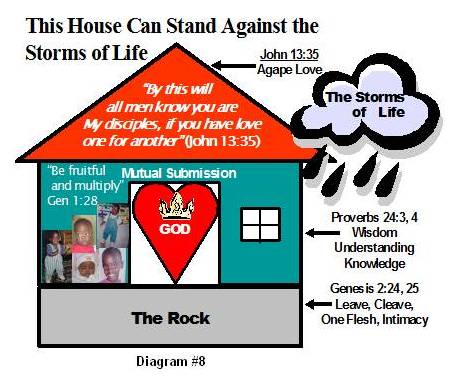
Slide8How do children fit into the Biblical Model of marriage?  Genesis 1:28a states, “And God blessed them, and God said to them, ‘Be fruitful and multiply, and fill the earth…’” Children are given to couples as a blessing and are neither a requirement nor the sole purpose for marriage.  In Diagram #8, we see that children are not part of the “structure,” which includes the foundation, the walls, and the roof.  Rather, they are given to the couple so that they may be nurtured in the wholesome environment of a Christian family.  This is where they will be sheltered and cared for and where they will receive the love and acceptance of godly parents.  This is also where they will receive instruction and training for godly living.

Proverbs 22:6 instructs parents to “train up a child in the way he should go, and even when he is old, he will not depart from it.”  A child who is raised with biblical values will become a vessel for service in God’s kingdom and also become a tremendous blessing to the parents and family: “A wise son brings joy to his father” (Prov. 15:20).  Nothing brings greater joy to a parent’s heart than a child who loves God and walks in His ways, but if we disregard the guidelines that God has given to us as parents, we will likely reap a harvest of grief and bitterness instead of joy: “A foolish son brings grief to his father and bitterness to the one who bore him” (Prov. 17:25).

What About the Childless Marriage?

What about couples who are unable to have children?  For a variety of reasons, some people cannot have children; various physical and psychological conditions can affect a couple’s fertility.  God has a purpose for every marriage—regardless of whether they produce children or not.  Christians have been given the promise that, “God causes all things to work together for good to those who love God, to those who are called according to His purpose” (Rom. 8:28).  Even a childless couple can have a complete, fulfilling marriage—one that brings glory to God by manifesting His agape love.  If we truly believe that God is able to work all things together for good, we must also believe that God can use even barrenness for good.  In a later reading, we will discuss the matter of adoption. Adoption is a viable option available for a childless couple who really desires to have children.

GOD’S COMMAND TO “SUBDUE” AND “RULE”

After God pronounced His blessing upon Adam and Eve, He also gave them a command in Genesis 1:28b.  He told them to “subdue [the earth] and rule over the fish of the sea, and over the birds of the sky, and over every living creature that moves upon the earth.”  Together, Adam and Eve received this command which established the perspective that a biblically-based marriage is one that empowers people to make an impact in the world where they live.  When God told Adam and Eve that they were to subdue and rule, He established a biblical model for marriage.  Couples, therefore need to understand that their marriage is not without purpose but that it is established through their relationship with each other and God.  Every couple should serve God in unity and cooperation, loving each other unconditionally—with intensity and passion—and combining their gifts and talents in order to bring glory to God through fulfilling His purpose for their marriage.

IN CONCLUSION

We have examined the differences between the Biblical Model and the two secular models of marriage and have discovered that what makes a marriage biblical has nothing to do with their cultural differences.  What makes the difference is the values system the couple chooses to live by.  The biblical marriage is governed by the law of Agape love and a Christ-like attitude and heart and stands in stark contrast to marriage based upon the world’s values of self-centeredness and personal happiness. We therefore conclude that marriages from  every culture, whether African traditional or modern Western, can be biblical if they follow God’s blueprint for marriage.

God calls His people to a life of servanthood—a life in which people willingly sacrifice for the sake of others.  The essential difference between a biblical and secular marriage is based on the central question: Who has the authority in the marriage?  If God is the ultimate authority in the marriage it will be governed by His law of mutual love and submission (Ephesians 5:21). Therefore, any marriage regardless of the cultural context and background, will be God-honoring and fulfilling for the couple.

Jesus was speaking to Christians in His Sermon on the Mount when he used the parable about building a house. He was warning the believers what would happen it they heard His words and did not act upon them.  Ask yourselves this question: Are we building our marriage upon sand or upon the Rock? The end result will be the same whether the couple is saved or not.

Bibliography:

  1. Brown, Jeffrey and Pattiejean, The Total Marriage, Autumn House Publishing, Granthan, England, 1999.
  2. Dobbins, Richard, Building Families that Last (Leader’s Guide for video series), Emerge Ministries, Akron, OH.
  3. Mitchell, Costa, A Practical Guide to Intimacy in Marriage, Vineyard International Publishing, Cape Town, SA, 1990.
  4. Prince, Derek, Marriage is a Covenant, Whitaker House, New Kensington, PA, 1978.
  5. Swindoll, Charles, Strike the Original Match, Multnomah Press, Portland, OR, 1981.
  6. Trobisch, Walter, I Married You, Harper and Row Publishers, San Francisco, CA, 1971.
  7. Van Pelt, Nancy L., To Have and to Hold, Southern Publishing Association, Nashville, TN, 1987.
0

The Rooster with the Raspy Voice was an Answer to Prayer

As a new believer, I yearned to have a meaningful prayer life. However, I soon discovered that whenever I attempted to spend quality time in prayer, I had difficulty concentrating because my mind would wander and I would get easily distracted.  If I tried to pray at night, I was usually so exhausted from the day I would fall asleep after two minutes.  At that time in my life, mornings were an even greater challenge because I was a late night person who hated to wake up in the morning and could barely get out of bed in time to get the kids off to school on time.  Needless to say, in my disorganized state, it was pretty chaotic around the Hayburn house every morning and we were late almost everywhere we went. Thus, waking up early was not a good option for me for a long term solution. Finding time during the day was hardly an option because sitting still was impossible for me.  Once my brain switched on in the morning, it was, off and running! and that was the end of any peace and quiet for me.

When we returned from a three-week mission trip to Kenya with our church in January 1983, I had a incredible experience that changed the course of my life.  At that time I started reading books on prayer and I became desperate to learn how to pray like the prayer warriors I had read about. One day I decided to fill the bathtub as full as possible and submerge myself so that all that remained out of the water was my nose.  It was so quiet and peaceful that I could actually focus my attention on the Lord. That was an amazing discovery for me.  I realized that the secret to my prayer life was peace and quiet!  However, it became a bit of a challenge to arrange my day so that I could have a long soak in the tub every time I wanted to have quiet time with the Lord.  I also didn’t like my skin getting all shriveled up like a prune every time I prayed. Besides all that, life was hectic taking care of a husband and two children and keeping up with an active ministry in the church, taking voice lessons so I could learn to sing like Sandi Patti, working part time at the Christian Elementary School, and taking night classes for my masters degree.  I remember crying out in desperation for the Lord to please help me.  I felt like I was drowning in over-commitment and I desperately wanted to spend time with the Lord without having to be submerged in a bathtub.

In the meantime, the Lord was not only busy helping me sort out my life, but He was also working out a plan that opened the door for us to return to Kenya for a 2 ½ year special assignment.  Time does not permit me to describe all the miracles and events that led to this drastic, life-changing decision to pack up and move our family halfway around the world.  That will be the topic for another chapter of memoirs entitled, How a Kidney Stone Prepared Me for the Mission Field.

All I can say is, in record time—approximately nine months from our first inquiry about the possibility of returning to Kenya—our Foreign Missions Department processed our application, we went through orientation, and with the help of our senior pastor we raised our budget, and we arrived in Nairobi, Kenya for our first term as missionaries on January 1, 1985.

Amy playing with her doll in the front yard of our house 192

Amy playing with her doll in the front yard of 192

Our house was located in an African housing area called Buru Buru located on the outskirts of the city.  At first, it was really strange to be the only white people in the community surrounded by people who looked at us with cautious curiosity.  We lived in house number 192, which was a two-story, three bedroom townhouse with a combination living room/dining room and a tiny kitchen. The house was small but cozy.  Mark and I took the bedroom located at the front of the house overlooking our neighbor’s courtyard. The girls shared a small room with twin beds and a small chest of drawers.  We turned the third bedroom into a sitting/reading room.

Jennifer on the front porch of 192

Jennifer on the front porch of 192

I had always thought that roosters were supposed to live on farms and crow at dawn to usher in the new day.  At least that was until we moved into 192.  As we were tucking the girls into their beds the first night, Jennifer asked how she would know when it was time to wake up.  Mark thought he was being clever when he told her to get up when the rooster crowed.  How surprised we were at 4:30 the next morning when we heard our neighbor’s rooster, whose cock-a-doodle-do sounded more like an elephant with a bad cold clearing his trunk. It was so loud I actually thought it was in our house. This scrawny feathered fowl that belonged on a farm just happened to be roosting right outside of my bedroom window. When Jennifer heard the rooster, she obediently came and stood at our bed thinking it was time to wake up.  When we realized it was only 4:30 in the morning, we told her to go back to bed.  This was one of my first experiences with culture shock as a missionary—getting used to a rooster perched outside of my bedroom window that thought wake-up call should be 4:30 AM.

Jennifer doing homework in our first mission home

Jennifer doing her homework

From our first night in 192 until we moved into another missionary’s house six months later to house sit for a year, the rooster faithfully woke me up at 4:30 AM. Everyone else in the family became so accustomed to the obnoxious squawking that they were able to sleep right through it. At first, I was frustrated but then one night I decided to get out of bed and go into the little sitting room and spend some time in prayer. The room was so small it could only accommodate a small two-seat sofa and a wooden table with a lamp.  I curled up on the sofa in the darkness and quiet and started talking to God.  It was so peaceful and quiet that I found myself talking to the Lord about everything without getting distracted.  That was exactly what I needed—quiet and darkness with nothing to do but pray—and I didn’t even have to submerge myself in the bathtub.

We only lived in 192 for six months before we were asked to house-sit for Spud and Joyce DeMent when they went home for furlough.  The interesting thing about the rooster with the raspy voice is how God used it to help me establish the daily discipline of a meaningful prayer time. It had always intrigued me when I would listen to veteran Christians sharing about how much they cherished their quality time in prayer and their testimonies about how God would speak to them and answer their prayers.  I had never experienced anything like that and I desperately wanted what they were talking about. With a little help from my Swahili-speaking rooster, I was on my way to discovering the joy of communing with God every day.

I found myself looking so forward to that time every morning before Mark and the girls woke up that when we moved to the DeMent’s house, I decided to set my alarm just in case I would happen to sleep through since I wouldn’t have the rooster to wake me up anymore.  What ever happened to that woman who couldn’t get out of bed in the morning? This precious time had become so special and I discovered how much I needed that time with the Lord. I also discovered that prayer is really a conversation with someone with whom you have a relationship. Over the days, weeks, months, and years, this time with the Lord praying and reading His Word was the key to my spiritual growth and I believe was my source of insight and wisdom that I knew, at times, was beyond my mortal reasoning.

As I look back over the forty-one years I have journeyed with the Lord, I marvel at all the unique ways God has answered my prayers.  I have learned that God always answers my prayers! Some answers were “Yes!” and came instantly and some were total miracles. Other times His answer was “No,” which in retrospect I would discover that it was the best answer after all. Other answers took years to unfold, like my prayer asking God to teach me how to pray. He answered this prayer by leading my family to a foreign country, thousands of miles away from home, and then lovingly placing a rooster with a raspy voice under my bedroom window.

0

One minute she didn’t have a pulse—The next minute she was drinking tea

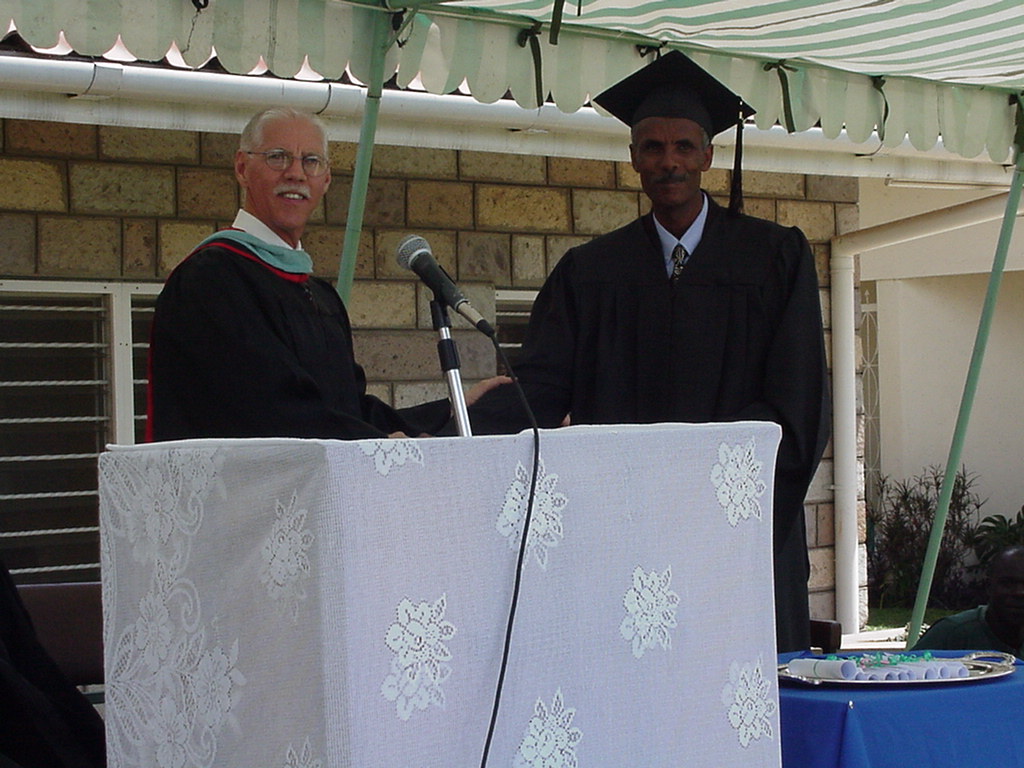
Mark as Principal of EAST at the MA Graduation Ceremony

Mark giving out degrees at the Graduation Ceremony

It was June of 1992 and we were wrapping up our second term in Kenya where Mark was serving as the principal of East Africa School of Theology in Nairobi and I had been teaching the Marriage and Family course.  We were  packed and ready to return to the States for furlough when one of our students invited us to minister in his church, which was about a three-hour drive to a little village situated on the outskirts of Nyahururu, a hilly, rural town in Kikuyu country located on the north-western side of the Aberdare Mountain Range.

When we arrived, we were greeted by a small congregation which gathered in a simple one-story rectangular church made of wooden slats and a mabati (tin) roof. It had about two windows that were opened to allow for some fresh air to fill the dusty room where the floor was covered with saw dust that filled the air, especially when the people danced during worship.  They were crammed into the small sanctuary like sardines and the children either sat on the floor in the front or played in the yard outside of the church.  The pews were tree stumps sunken into the earthen floor with boards attached forming narrow benches. They were so close together that the people’s knees were like seatbacks for the people in the rows in front of them.

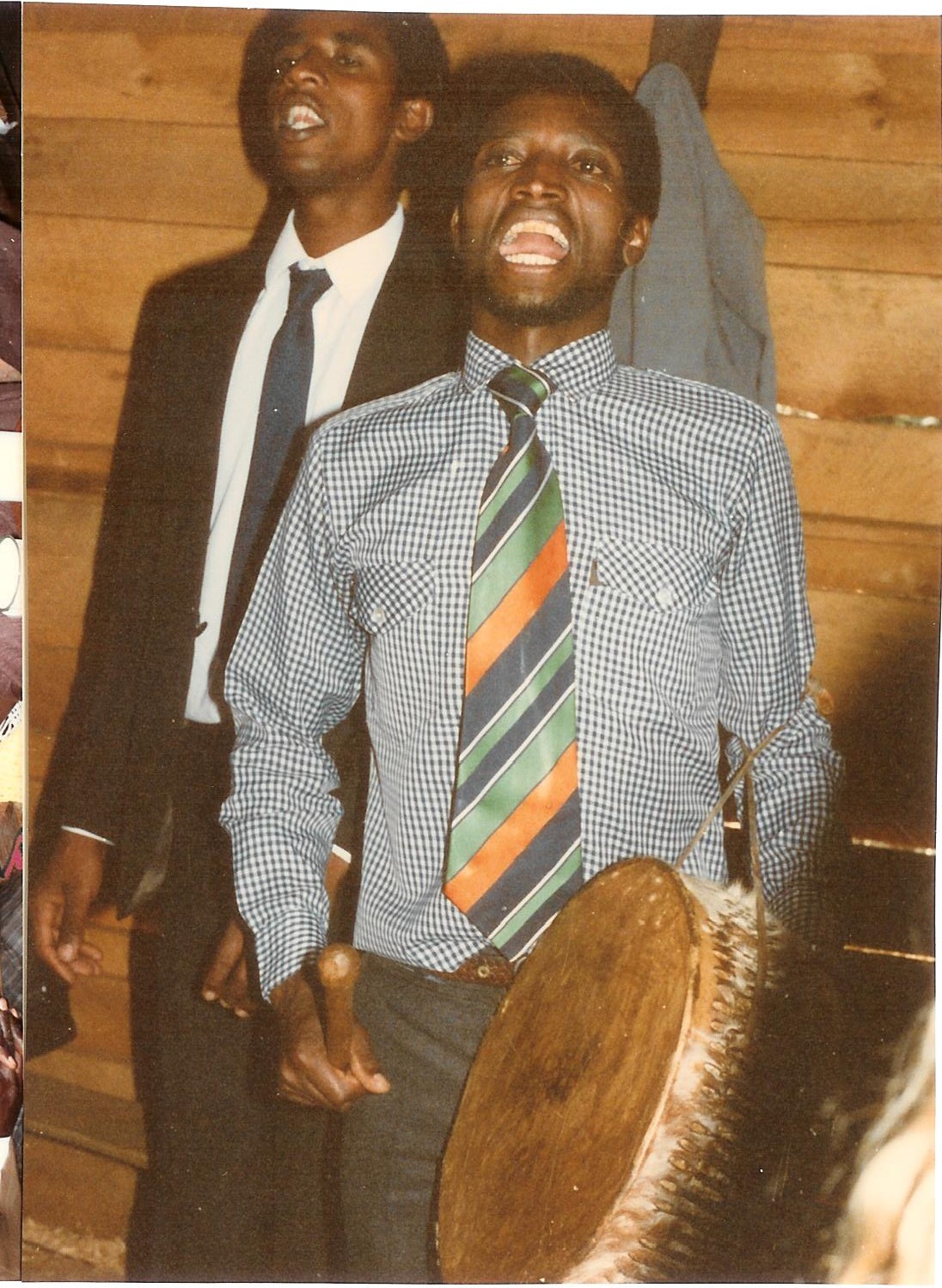
Leading the congregation in worship to the beat of the drum

Leading the congregation in worship to the beat of the drum

The worship service filled the sanctuary with loud singing in a pentatonic style of African melody that tells a story.  The stories are many stanzas long because they tell of battles with evil spirits and the Devil, God’s miraculous victories and deliverance, and always end with the believer’s final destination in glory.  The people also love to act out their songs with hand and body motions which enhance their joy in telling the story.  In unison they dance to the beat of their instruments comprised of handmade cymbals made from pop bottle caps and attached to a metal ring played with a stick of wood or metal and drums made from cow hide that they either beat with their hand or a stick.  Even though we couldn’t understand their language, we could feel the presence of God in the midst of their dancing and worship.

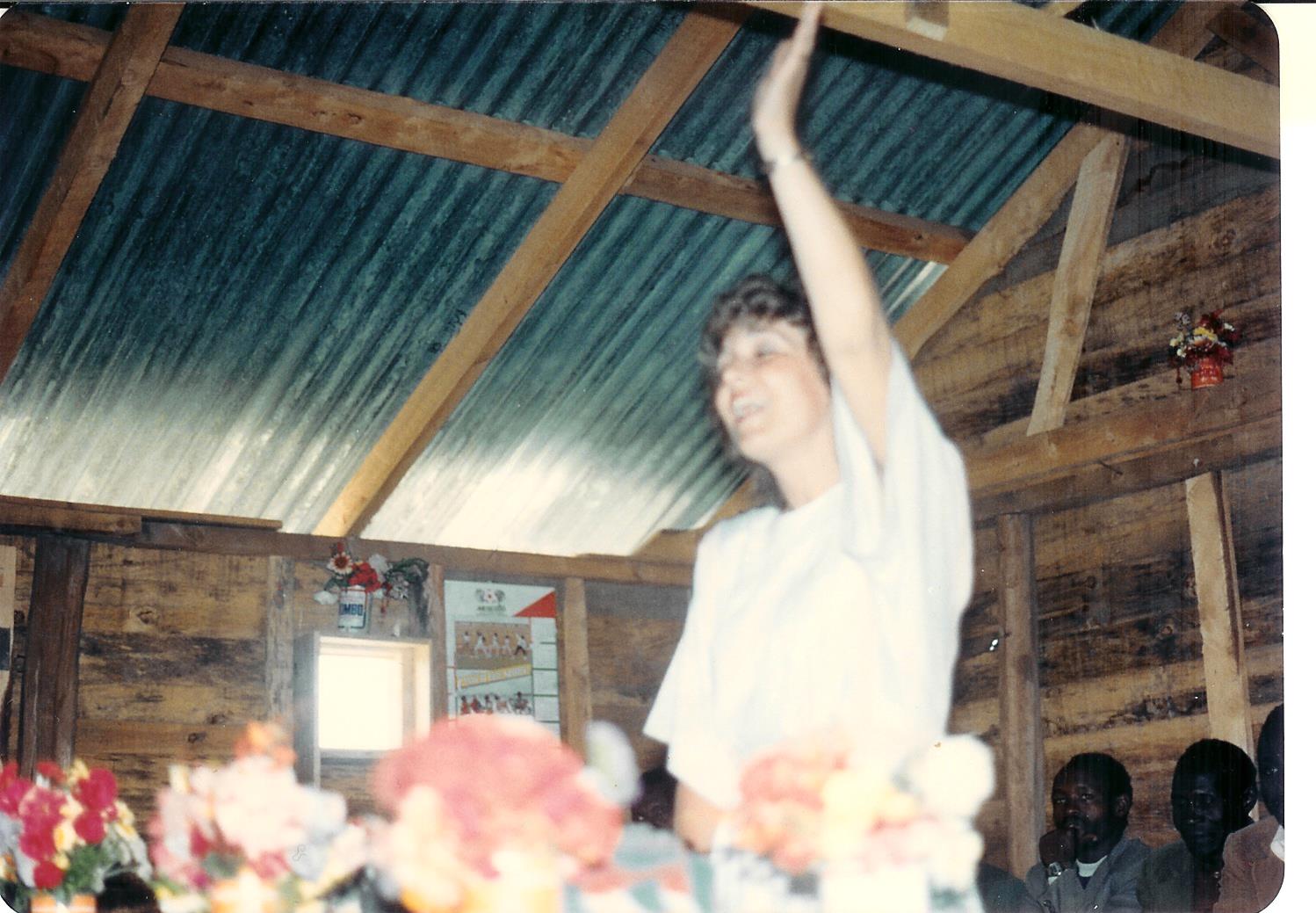
Judy singing a special song before Mark' sermon

Judy singing a special song before Mark’ sermon

Before the service began, the student just happened to mention something he had neglected to tell us beforehand.  The village where the church was located had been hit with a cholera epidemic and many people were deathly sick and some had even died.  If we had known this beforehand, we would probably have declined the invitation. However, the service began and everything was progressing as usual—introductions, testimonials, worship that shook the rafters, I sang a special song accompanied by my cassette tape, and then it was Mark’s time to preach.

A few minutes into the sermon, Mark noticed an elderly woman on the second row starting to weave and then suddenly collapse on the floor.  The people closest to her huddled around her and the service came to a halt.  All of a sudden, I saw several men hoist the woman up over their heads to carry her out of the sanctuary.  Those who were close enough were laying hands on her and the others were reaching out and praying for her.  Mark also laid hands on her and the pastor asked him to lead the congregation in a prayer. The Kikuyu prayers were fervent and loud and shook the building.  After the prayer, she was carried out of the sanctuary.  The pastor encouraged the people to settle back down in their seats and told Mark to resume his preaching.  It was as if nothing out of the ordinary had just taken place.

We didn’t know what happened to her until the service was over. A man who had been in the service spoke to us afterwards and told us that he was a nurse and worked at the local medical clinic in the village.  He said the woman had cholera and told Mark he had not been able to find a pulse when they carried her out.  However, when the service ended and everyone filed out of the church we found the woman sitting on the ground under a tree drinking tea.  The people began praising God for a miracle.  For precautionary measures, the nurse announced that everyone who had come in contact with the woman should take a pill that would protect them from cholera.  Even though Mark had come in direct contact with her, we decided we would trust God to protect us.  To this day, we believe that God kept His hand on us and we thank Him for the opportunity to witness His miraculous healing power.

0

The Dream that Changed his Life

This is a true story about a man named James, in Cape Town, SA

Some months back, a man by the name of James invited Mark and me to do a session on the topic of “Romance in Marriage” at a fund raising banquet for their Bible school. Before the banquet got underway, I had an opportunity to sit and chat with James. James was a very soft-spoken and gracious man and I remember being so impressed with his gentle and sweet spirit and his love for Christ. I was blown away when he told me that he was an ex-inmate and a former “26” leader of a prison gang.

A gang member in a Cape Town Prison

A typical gang member in a Cape Town Prison

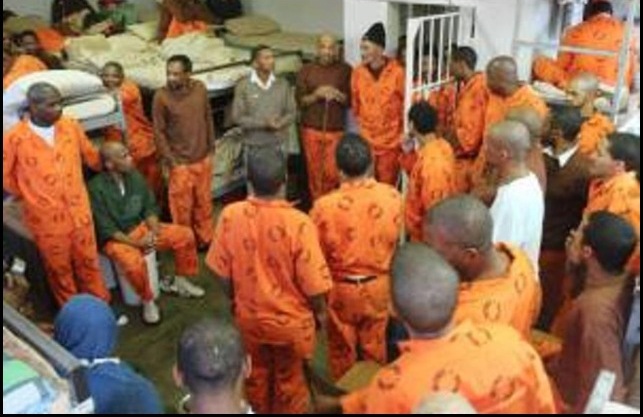
In Cape Town prisons, gangsterism is a common factor for many of the prisoners. The prison allocates different gangs into three separate sections on a single floor, accommodating a total of 500 to 750 gang members. The various gangs are generally called “The Numbers” (the 26s, the 27s and the 28s), and they are enormously powerful in their given shared cells. Gang rules involve extreme violence, which also includes sexual violence. James was in prison for 12 years and was given the nick name, “The Nightmare of the Prison,” by the warden and officers of the prison.

A cell block of prisoners in a Cape Town prison

A cell block of prisoners in a Cape Town prison

James told us that one night God gave him a dream that completely changed his life. The dream was so powerful and shook him so hard, that he immediately upon awakening from the dream gave his heart to the Lord and became a sold-out, born-again Christian. He was finally released on parole in 2008 and started the Jahaziel Bible School which is located in an Assembly of God Church in Kraaifontein. James now serves as the principal of the school. He is also married to a beautiful Christian woman whom he met in the church and they also have a small child. God is using him in a powerful way through the ministry of training young men and women in the Word of God and preparation for ministry. He told us that we would not be able to comprehend the terrible things he had done and everything from which God had delivered him in his former life.

James’ experience is only one of many bearing witness to how miraculous events, visitations by angels, dreams, visions, and other amazing and unexplainable encounters in the supernatural have radically changed people’s lives. We believe God is reaching out to many lost souls as we draw nearer to the Second Coming of Christ.

Following the Day of Pentecost and the miraculous outpouring of the Holy Spirit, Peter quoted a passage from the Prophet Joel who had predicted what would happen in the days preceding the return of Christ: “And it shall be in the last days, God says, that I will pour forth of My Spirit upon all mankind; and your sons and your daughters will prophesy, and your young men shall see visions, and your old men shall dream dreams; even upon My bondslaves, both men and women, I will in those days pour forth of My Spirit and they shall prophesy. And I will grant wonders in the sky above, and signs on the earth beneath, blood, and fire, and vapor of smoke. The sun shall be turned into darkness, and the moon into blood, before the great and glorious day of the Lord shall come. And it shall be, that “every one who calls on the name of the Lord shall be saved.”  ACT 2:17 – 21.

0

Angels in Uniform

Image

Global School of Theology – Western Cape

After serving in Nairobi, Kenya for 19 years, Mark and I were called to Cape Town, South Africa, and on February 6, 2006 we assumed the leadership of Global School of Theology-Western Cape (GST-WC).  During our first four years, Mark was the principal and I served as his Administrative Assistant, an advisor to the Student Life Office and taught the Marriage and Family course.  As a current member of the Board of Directors, Mark has been tasked with the responsibility to assist in drafting the documents needed for the re-accreditation process which culminates with an extremely important inspection at the end of this month. Literally, the fate of the future of our school will be determined by this inspection. Please join us in prayer that the Lord will go before us once again to give the Bible school favor with the South African government.

GST-WC is not the original name of the school. A few years ago, it was called Cape Theological Seminary. However, when the school opened its doors in 1986, it was called Cape College of Theology.  The reason for all the name changes is not relevant to the story which takes us back to the year 1982 and a missionary by the name of Gene Grahams. The following is an excerpt from his personal account of the day he met “Angels in Uniform”:

“I am going to establish a Bible college in Cape Town, and I want you to help Me.”

That hot February afternoon in 1982, I was pondering the victories the Lord had given my wife Phyllis and me during our years in South Africa. Suddenly, I heard the Lord tell me He was going to establish a Bible college in Cape Town. He indicated that the school would be different  from any Bible college in the country: it would be multiracial. Students of different races would live in the same dormitories.

“I’m going to use this school to bring reconciliation between races, between families, and between churches,” the Lord said. “I already have the place reserved, and in My time I will lead you to it.”

“Lord,” I prayed, “if this is You, please repeat Your message.”

I heard the message again, word for word, and I knew I was hearing the voice of God. My wife and I went to Cape Town, on the southwest coast of South Africa, and looked for property for the school. But we found nothing.

In addition to property, we needed a permit to open the school. But at that time, obtaining an unrestricted permit for students of different races to attend the same residential school was nearly impossible.

I was granted an interview with the private secretary to a government cabinet minister to discuss the possibility of obtaining a permit. As I got into our Speed-the-Light car to go to the meeting, I began to weep. I felt the presence of two individuals in the car, one sitting next to me and one in the back seat. But I didn’t see anyone.

My appointment was at the Hendrik Verwoerd Building. As I drove, I realized I had forgotten to ask where it was. I knew the offices of the cabinet members would have to be near the parliament building, so I decided to park there.

Two policemen were standing nearby when I got out of the car. I hurriedly approached them. “Excuse me, gentlemen,” I said. “I have a very important appointment at 2 o’clock in the Hendrik Verwoerd Building. Would you please direct me?”

One of the policemen stepped forward with a smile and said, “ Could I have the privilege of accompanying you?”

My, I thought, these are the friendliest policemen I’ve ever met.

As we walked, the policeman said, “You are here on very important business and God is well pleased with it. God has chosen you to help Him in this school.”

I had never seen this man before, I had said nothing to him about the school. In a few words, I tried to explain my mission.

Then the policeman said we would face problems in establishing the school. “From time to time, you will wish somebody else could do it. God’s will is going to be accomplished, but it will be delayed if you don’t follow as He leads you.”

We arrived in a large courtyard in front of a building. “This is the building where you have your appointment,” the policeman said, “I have one last thing to tell you before I leave. Don’t take any credit to yourself for what God is going to do.”

My mind was going in 40 different directions, and I glanced toward the building for a moment. Then I thought I would ask the policeman if I could meet him for lunch. I wanted to ask him how he knew these things. But when I turned back, he was gone. The courtyard was large, and there was no place he could have stood without being seen. Nor could he have taken leave of me without me noticing.

Thank you, Lord, I prayed. I never realized what great importance you placed upon this project. Help me to be faithful in working with You.

As they say, the rest is history.  CCT>CTS>GST-WC became the first institution during the Apartheid era where blacks, coloreds, and whites were permitted to attend the same school and even share the same dorm rooms.  This was UNHEARD OF in those days!  God had given Gene Grahams favor with the government officials when he insisted that the school be integrated. Over the next twelve years when Apartheid ended in 1994, the seminary remained fully integrated and remains so to this day.

0

Part 5 and Vanita says, “We are having fun!”

Vanita says, "We are having fun!"

Vanita says, “We are having fun!”

Judy: I hadn’t heard from Vanita in a few weeks so I thought I would write and see how things have been going at her house. This was her reply:

Hi Judy!

I cannot believe it! I was just thinking about you over the weekend!

Things are going well with my family. We went on our first family holiday about 2 weeks ago. We took a road trip to George which is about 6 or 7 hours casual driving. Kids were super excited and they definitely deserved to be spoilt!

Zoey is opening up to me about the pressures of school, her peers etc. I think because I now listen and give her choices and consequences scenarios instead of telling her what she should do! I’ve also noticed that she takes better care of herself these days – not sure how that fits in here though. She asks me to braid her hair in the evenings before bed and she is taking her vitamins without me telling her to!!

Judy: This is absolutely wonderful!  Isn’t it amazing how Zoey is responding to your “consultant mom” approach, rather than the “militant mom” who ran the house like a drill sergeant.  As Zoey continues to invite you into her life, take these precious opportunities to talk to her and find out who she is on the inside.

Adam, oh my goodness, Adam is thriving! He’s gone from NOT wanting me to take photos of him at all to SHOWING OFF in front of the camera! His behaviour has turned around 180 degrees from a shy boy lacking confidence to a noisy negotiator!!! His speech therapist is very happy with the improvement!

Judy: This is amazing!  Adam is obviously a bright and outgoing little boy. When parents treat their children with respect, they literally blossom. Even the speech therapist is noticing the difference.

For example on Saturday evening around 8 pm Adam asked if he could have a banana. I said I didn’t think it was a good idea because bananas are heavy and it’s gonna hurt his tummy. He said, “PALLEAASSEE Mommy!” I told him he has 2 options, he can either eat the banana and when his tummy aches he must go lie on his bed and cry softly and not come to me or his daddy, OR I can keep the banana for his breakfast in the morning. He chose the latter and we both won! And he always gives me “options”. Yes, my 5 year old uses the word “option”! He hates bathing so the other day he suggested that instead of bathing him that night (because he was tired) I should wash him the next morning (which in our house is a shower in the bath tub, which we do every other night to save) and when he comes from school I can then bath him. I marvel at how his brain works – he’s not arguing about having a bath but giving me another “option”: 2 days = 1 bath and 1 wash which would have happened anyway. It’s like his own “love&logic” system!!  We are having fun!

Regards
Vanita

Judy: It is remarkable how a child will respond when he feels like he has a choice. Adam is catching on quickly to this concept and as a result, you are giving him the opportunity to use his brain to think through his own problems and make wise decisions. Instead of this becoming a battle of wills, you have given him the freedom to choose, which is a character trait he will need when he becomes an adult. 

I am looking forward to hearing more great stories about the amazing transformation taking place at the Meyer house!

Until next time,
Judy


0

Part 4 of Vanita’s Journey “better times!”

"We'll see what happens when he expects his pocket money tonight."

“We’ll see what happens when he expects his pocket money tonight.”

Hi Judy,

Thursday, April 24th

So yesterday went slightly better… Adam’s still not keen to do his daily chore (sweeping the stoep) but I did get him to bath on time. We’ll see what happens when he expects his pocket money tonight.

Judy: If you are having a bit of trouble with Adam doing his chores, I would like to point you to a great 4 minute Youtube on-line with Love and Logic that talks about a great strategy that really works.


How to Get Kids to do Their Choreshttp://www.youtube.com/watch?v=TQLu0Ys7wA0
Basically, it talks about the PARENT’S RULES for getting kids to do their chores.

Rule number one: NEVER tell the kid to do the chores RIGHT NOW. Provide a deadline in the future far enough in the future where you will have plenty of time to figure out what you are going to do if he doesn’t do it. Some say, “Do it!” “Do it right now or else!” and have no idea what “or else” is.

Rule number two: NEVER REMIND. If you want your kids to listen, you say something once and then something happens. Then if they say, “I didn’t hear.” We say, “How sad. Maybe you’ll listen better next time. There will always be another time and this is what’s going to happen.” Come up with a consequence and then allow him to make the choice. You stay cool, calm and empathetic when he forgets or doesn’t do his chore. Use lots of empathy and say, “So sad. Too bad you won’t be able to… ( i.e. “stay up an hour later with your sister tonight and watch a movie”… or something else that will make the point). Perhaps Adam would be more agreeable to do what he is required to do if he feels like he has some choices as to when the chore needs to be done (i.e. “Do you want to sweep the stoep before or after dinner?”).

I finally decided to let Zoey dry her own hair. Now she's loving it!

“I finally decided to let Zoey dry her own hair. Now she’s loving it!”

Zoey is flourishing. Yesterday she suggested that she wash her hair! This, coming from a child who STILL hates hair wash days. Now any mother with course-haired girl children will tell you it’s a nightmare! We both normally end up frustrated because I’m pulling and tugging and apparently burning her whole head! Last Thursday I decided to let her blow dry her own hair! I thought that I should empower her instead of doing it for her! Now she’s loving it!

Judy: I believe Zoey is responding so beautifully because you are empowering her and positively affirming her. This proves that when the parent remains calm, pleasant and firm, children will respond and thrive. How wonderful that you are making these changes now before she reaches the difficult teen years.

And me…..? I’m not so stressed in the mornings anymore. I don’t have to run around like hired help and take them breakfast in bed so they can wake up, and when Adam decides he’s too tired to eat cornflakes I have to dress a +30kg (66 pound) child in his sleep!

Judy: This reminds me of another story about a child who wouldn’t get out of bed in time for breakfast. The wise mother simply established the rule that breakfast is served from such-and-such a time and then the kitchen is closed. Anyone who misses breakfast will have to wait until lunch to eat. Once the child experienced a morning feeling hungry (the natural consequence for being late), he made sure he was up and ready for breakfast on time thereafter.

What an absolute blessing to say goodbye to them in the mornings when they leave for school….without thinking to myself, “good riddance”!!!

Tuesday, April 29th

I’m so excited – Adam’s speech therapist is very impressed with his drastic improvement! She says she was worried about his anger but now he has lightened up. She’s been suggesting to me for the past 3 or 4 years to go seek help with parenting Adam as it would help his speech.

#bettertimes#

Regards,
Vanita

Judy: What has probably helped Adam may simply be the result of taking “your” anger out of the equation. If you look at the rules of Love and Logic, Jim Fay says:

Rule #1: Adults set firm limits in loving ways without anger, lecture, or threats.

Rule #2: When a child causes a problem the adult hands it back in loving ways.
1. In a loving way, the adult holds the child accountable for solving his/her problems in a way that does not make a problem for others (CD LL #14) or  http://www.loveandlogic.com/documents/guiding-children-to-solve-their-own-problems.pdf

2. Children are offered choices with limits (CD LL #15) or  http://www.loveandlogic.com/documents/guidelines-for-sharing-control-through-choices.pdf

3. Adults use enforceable statements (CD LL #25) or   http://www.loveandlogic.com/documents/using-enforceable-statements.pdf

4. Adults provide delayed/extended consequences (CD LL#22) or    http://www.loveandlogic.com/documents/delayed-consequence-parents.pdf

5. The adult’s empathy is “locked in” before consequences are delivered (CD LL #23) or http://www.loveandlogic.com/documents/instant-empathetic-response.pdf

I am really looking forward to hearing from you again. Keep up the awesome work. I believe many people will be encouraged and inspired by your story.

Blessings,
Judy


0

Part 3 of Vanita’s Journey: “Our Schedules went out the window and ‘Militant Mom’ was back!”

The schedules went out the window and "militant mom" was back!"

The schedules went out the window and “militant mom” was back!”

Hi Judy,

A 4-day holiday was no good for us. We had my 2 step kids over for the Easter weekend so schedules and Love& Logic went out the window and militant mom was back! I was thinking yesterday that militant mom probably kicks in automatically when I feel I cannot cope.

Judy: Fatigue and stress often trigger old patterns of behavior, so the next time “militant mom” shows up unannounced, just ask the kids to forgive you and tell them you will try harder next time.  You can even ask them to pray for you. I believe they will respect you for that as you model for them how everyone, including Mom, needs to take personal responsibility for their actions.

Anyway we had to start over again yesterday…:-( …and next week is also school holidays, so again, our schedule is going to be disrupted! Oh well, …once the holidays settle then maybe we can have longer lasting results?

Judy: Whenever necessary, sit down as a family and talk about making special schedules for holidays and no-school days and even talk about when your step kids come over because the routines may have to be adjusted. Your step-children will also benefit from being included in this process of what you are implementing in the home with schedules, chores and new house rules, etc and you can also make charts for them. That will make them feel included in the family and make things more consistent.

So yesterday we went back to the beginning. Adam is no longer eager. I suppose the novelty has worn off. But then he started throwing tantrums and the like from Monday, all day yesterday, and today. Not sure what’s going on with him because he never did this before. I’m just ignoring him for now.

Judy: As far as Adam’s unusual tantrums is concerned, you might sit down with him calmly (not in the heat of the moment) and see if you can find out what’s bothering him. Sometimes there are reasons behind the out-of-character behavior. In this case especially, ignoring his tantrums is a good way to discourage them and use your one-liners like “I love you too much to argue.” If they continue and escalate, you could send him to his room for “time out” so that he can get control of himself and then tell him he can join the family when he can act “sweet.” The rule is that as soon as you are “sweet” you can come out—but not immediately. The child needs to remain quiet for at least 5 minutes before he is allowed to come out and join the family and must also be responsible for putting his room back together again if he trashes it in the heat of his anger.

Zoey is doing well, keeping to her schedule as much as possible. I went on an interview yesterday and afterwards took Adam to speech therapy so she had to go to my mom’s after school, which kind of threw her off a bit, but she got back in as close as we could. They were late for school this morning because I overslept and so Zoey suggested I put their lunch in the evening before…proactive I thought!

Judy: It’s interesting that Zoey is offering suggestions for how to make things go smoother. That is very impressive and you can use this as an opportunity to compliment her and let her know how much you appreciate her input. She sounds like the kind of child who really thrives on order and routine. I think you should tap into her ideas whenever possible, which will give her a feeling of worth and usefulness.

I also see this as another opportunity for you to set an example for taking personal responsibility: Whenever you drop the ball (i.e. if you happen to oversleep and the schedule gets thrown out the window, or you lose your temper and revert to “militant mom”, etc.) apologize and let the kids know you are also making yourself accountable and that at times you may even make a mistake.

Nothing more for now. Over and out.

Regards
Vanita Meyer

Judy: I am really proud of you and confident that you are going to make this work. Keep in touch and I will be praying for you. I believe many people will be encouraged by your story and that it is important to realize that success is all about not giving up.

Blessings,
Judy

0

Day #2 and Vanita is Amazed!

Vanita and her sister Crystal talking to Judy at the Parenting Seminar on Saturday

Vanita and her sister Crystal talking to Judy at the Parenting Seminar on Saturday

This is the e-mail I received on Day #2 from Vanita. I have inserted my comments throughout.

Good morning,

Yesterday was slightly more challenging as we didn’t take into account that Wednesday is church so we need to adapt the schedule to accommodate the fact that we leave home at 6pm!

Judy: This was the same problem I faced when putting the family (and myself) on a schedule. Because of church activities and other weekly responsibilities, I realized I needed a schedule for practically every day of the week. I also had to come up with a plan on “school off days” and “holidays.” You’re on the right track. I believe the Lord will give you wisdom as you sit down and strategically plan out your schedules.

Adam wasn’t happy that he had to bath earlier than what we agreed and I kept on having to explain it – he just didn’t want to “get it”. He’s the type of child that I remind from Sunday morning that it’s Monday the next day and which means school! Zoey, being older was more flexible.

Judy: This would be the perfect opportunity to use the technique, “Neutralizing Arguing” (see Love and Logic Article #26 on your CD). Read the article, “Neutralizing Arguing” with Youtube links by Kerry Stutzman at the end of this post:
Going Brain Dead: https://www.youtube.com/watch?v=BwhuW5pN9tQ
One Liners: https://www.youtube.com/watch?v=6FPxOezq4HQ
Energy Drain: https://www.youtube.com/watch?v=OkwkGr6P2FI
Empathy: https://www.youtube.com/watch?v=RlaGKM54U4I

Highlights of Day 2
Love&Logic is not easy to apply if you are a quick tempered person like me but I got an opportunity with Zoey.

In the morning I discovered that Zoey “misplaced” her PE togs somewhere and had to therefore wear something else (like she did last week). I then suggested that seeing that its week no.2. and she still hasn’t found it she’s going to have to get others. I further suggested that she start putting her weekly pocket money away to cover the cost of the togs because as we paid for the first set, its only fair that she pays for the 2nd set. She was shocked! Not sure if its because I didn’t scold at her or that I’m saying that SHE should pay for school uniform! Literally 5 minutes later she appeared wearing her PE togs! I think she just didn’t feel like looking for it. My comment was “oh good, I’m so glad you found it”. 🙂 #allroundhappiness#

Judy: This is awesome! You sound like a pro.

The other highlight is that when Zoey’s neighbourhood friends came over to visit I told them that Zoey doesn’t have friends over in the week anymore and she backed me up as it was her suggestion in the meeting!

Judy: Isn’t it amazing how the children take ownership when they feel they’ve had a say in making the policy?

I think the more we get into it, the easier it will become.

Judy: I guarantee it will get easier!

I’m tweaking the schedule to factor in prepping school clothes for the following day as this took up time Wednesday morning as well as on Wednesdays everything moves up by one hour because of church!

My hubby’s concerned that he doesn’t spend time with the kids now that they go to bed early. That’s something we’re going to have to work on as more often than not he only gets home at 9pm!

Its early days yet so hubby’s just “checking us out” for now.

Judy: What time does hubby go to work? If he doesn’t see them at night because they are in bed, does he see them in the morning or does that mean he doesn’t see them at all that day? This is one of the situations where you and your hubby need to sit down and talk about what you are trying to do with the scheduling and see if he would be willing to look at the power points and outlines so he can be on the same page. It is important that he be involved with the programme. He may feel the need to get up earlier in the morning so he can at least see the kids in the morning. Weekends or holidays will be when they have quality time together.

Friday is a public holiday so they will stay up late tonight and see him. What a pity we only had 3 days of our schedule. Next week’s also a short week and then there’s school holidays for one week after that!

I’m thinking perhaps our next meeting should be about a weekend and holiday schedule…..I wonder if I’ll get away with it? Lol 🙂

Judy: Absolutely you can get away with it. You are in charge and as you talk to the kids, tell them we as a family need to “solve this problem.” Ask them for their input. That will give them the sense that you are all in this together. When you invited Zoey into the discussion at your first family meeting, some of the things were her idea (ie with friends on school nights), she took ownership and backed up the policy. This is powerful stuff and you are doing awesome. Maybe you’ll write a book someday and help many other parents find their way.

Vanita Meyer

Neutralizing Arguing

1. Go “Brain Dead”
a. When the child starts arguing and throwing a tantrum, you have to stay in a thinking mode
b. Don’t listen to the things the child will say because it will make it worse
c. That is not the moment to correct disrespectful talking back

2. One-liner repeated over and over
a. If the child starts to argue, simply state “I love you too much to argue.” Or “I know.” Over and over again.
b. If child persists and won’t stop or escalates, just walk away.
c. Stay calm and don’t think about what he is saying.
d. If you try to reason, the child will feel like he has accomplished what he wants and he wins.
e. If you stay calm and repeat like a broken record in a kind and sympathetic voice “I love you too much to argue.” The child will eventually give up.

3. Energy Drain
a. If the child says something that is disrespectful, wait until after the heat of the moment is over and everyone is happy, then go back and talk about the issue of disrespect and the disrespectful words that were said.
b. Say, “When you said…. (ie “I hate you.” Or “You’re stupid!”) that is really not okay. That really drained my energy. What are you going to do to put energy back in me?”
c. You can say, “Here are a few things you can do to put energy back in me. Which would you like to do?” and give them 2 or 3 choices like:
1) Vacuum the lounge
2) Dust the living room
3) Clean the bathroom
4) Scoop up the dog poop in the yard
5) Sweep the garage
d. Then you say, “If you can’t choose something, I’ll choose for you.” And give him 10 seconds to respond. If he doesn’t respond in 10 second, choose something for him.
e. If the child doesn’t do it or forgets, (NEVER REMIND the child) then you say to the child: “This is so sad. Since you didn’t do (whatever the chore was), you didn’t put energy back in me so now you will have to stay home when the family goes to the movie tonight.” (or some other consequence that will make an impression on the child.)

4. The Instant Empathetic Response
Some Benefits of Delivering Love and Logic Consequences with Empathy
a. The child is not distracted by the adult’s anger.
b. The child must “own” his or her pain rather than blaming it on the adult.
c. The adult–child relationship is maintained.
d. The child is much less likely to seek revenge.
e. The adult is seen as being able to handle problems without breaking a sweat.
f. The child learns through modeling to use empathy with others.

0

Day #1 and Vanita’s Husband is Amazed

Vanita Meyer Parenting Seminar April 12, 2014

Vanita Meyer
Parenting Seminar April 12, 2014

I am starting a new Blog Category: Parents Sharing their Stories! Whenever I receive a testimonial from a parent who is trying Love and Logic and seeing it work miracles in their families, I will post them for all to see. We hope to expand this by sharing parents’ ideas with others on how to make simple changes that will impact the family in a positive way.

My first testimonial was received today (Wednesday the 16th) from Vanita Meyers following our Parenting Seminar on Saturday April 12th. About 43 people attended, including pastors, school teachers and Sunday School teachers, and even three Social Workers from Cape Town, and everyone seemed to enjoy their day and walked away excited about trying some new ideas and techniques in their homes. We introduced the parenting philosophy called, “Love and Logic”, which is an approach to raising kids that provides loving support from parents while at the same time expecting kids to be respectful and responsible, a philosophy founded by Jim Fay and Foster W. Cline, M.D. You can go on-line and learn more about it at http://www.loveandlogic.com

Here is Vanita’s story in her own words:

Hi Judy,

A good time was had by all on Saturday!

I am a recent stay-at-home mom to 12yr old Zoey and 5yr old Adam. It’s been 3 months at home and I still haven’t figured out how to get things running smoothly. I class myself as the militant mom, barking out orders and expecting perfection, shouting and stressed out!

We had our first family meeting on Monday night and decided what would be the reasonable expectations for chores. I was very surprised at what I heard! I typed it all out and said I would let them have a copy when they got home the next afternoon.

The next morning we struggled a bit because we weren’t prepared but at least their beds were made up and they got to school on time!

To my utter surprise when they arrived home from school while I was still talking to a neighbour Adam rushed in (without greeting – but with a sheepish grin). When I went indoors to see what’s going on he was rushing towards me with a broom and started sweeping the stoep! He has 2 daily chores, one of which is to sweep the stoep! Zoey, without even undressing started picking papers up on the garden (weekly chore). Needless to say at 5pm when I called Adam to come bath he DIDN’T protest but tells me “Good!” And when I finished with him Zoey went to shower WITHOUT me telling her to.

We were all in bed at 8.15pm last night and when my hubby came home at 9pm he thought something was wrong because the house was so quiet!

And that was just Day No 1!

I think involving them in planning their schedules made a HUGE difference other than me just telling them what’s going on the schedule. I tried a schedule before when Zoey was about 8, I think! And also they know what is expected of them especially Adam loves telling me what we are supposed to be doing now!

I’m looking forward to the rest of my life!

Thank you so much to you all!
Vanita Meyer