
Jesus likened our Christian walk to building a house. In this article we will use the analogy of building a house to contrast two secular views of marriage with the biblical view. We will compare the characteristics and values of the Traditional African Secular Model and the Modern Western Secular Model with the Biblical Model of marriage.
Regardless of cultural background, everyone who attempts to build their marriage on a foundation other than what God has established, Jesus said is comparable to being a foolish man who built his house on the sand (Matt. 7:26).
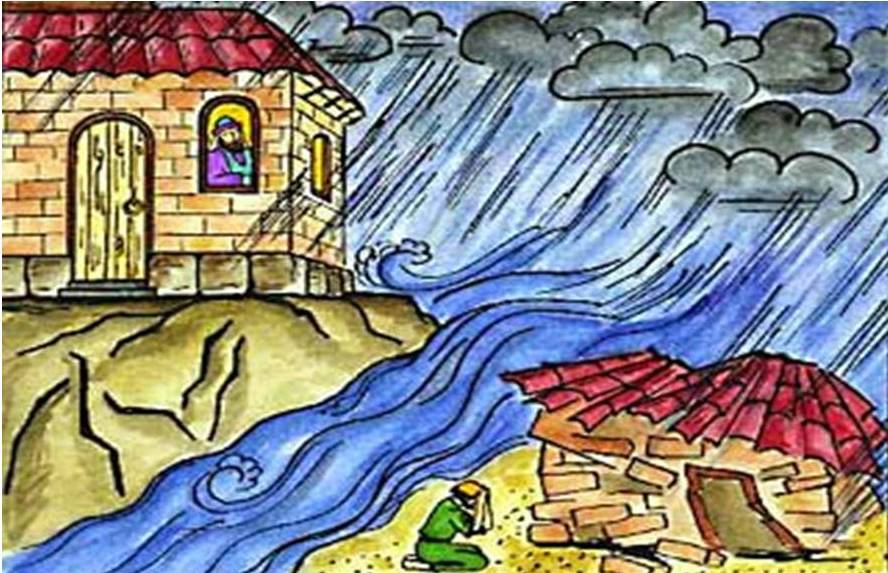
The Wise and Foolish Builders
Therefore everyone who hears these words of mine and puts them into practice is like a wise man who built his house on the rock. The rain came down, the streams rose, and the winds blew and beat against that house, yet it did not fall, because it had its foundation on the rock. But everyone who hears these words of mine and does not put them into practice is like a foolish man who built his house on sand. The rain came down, the streams rose, and the winds blew and beat against that house, and it fell with a great crash (Mat. 7:24 – 27 NIV).
MARRIAGE AND CULTURE
Marriage was established by God as a covenant relationship between Himself, a man and a woman. Though it was established by God, marriage must be lived out in a cultural context. The idea of marriage originates from God and He therefore has established specific principles on how it should be built. The Bible provides the framework and establishes principles that can be applied to any culture.
PREPARING TO BUILD
When someone decides to build a house, important decisions need to be made. First, an architect will be chosen to draft the blueprint and then the builder will enter into a legal agreement by signing a contract.
According to the African Traditional Secular Model, the architect is the god of this world (John 14:30), and the blueprint is their culture. In this marriage, the couple conforms to their cultural values and follows traditions passed down for generations. Their house closely resembles all the other houses in their community. In this marriage, the builder is the husband and his wife is his helper.
The only difference between the Modern Western Secular Marriage and the African Traditional Secular Marriage is that the husband and wife will tend to be more egalitarian in their approach. They too enter the marriage with their own ideas of what the house should look like and how it should be constructed. Both of these models for marriage conform to the values of their cultural context which are influenced by the ruler of this world.
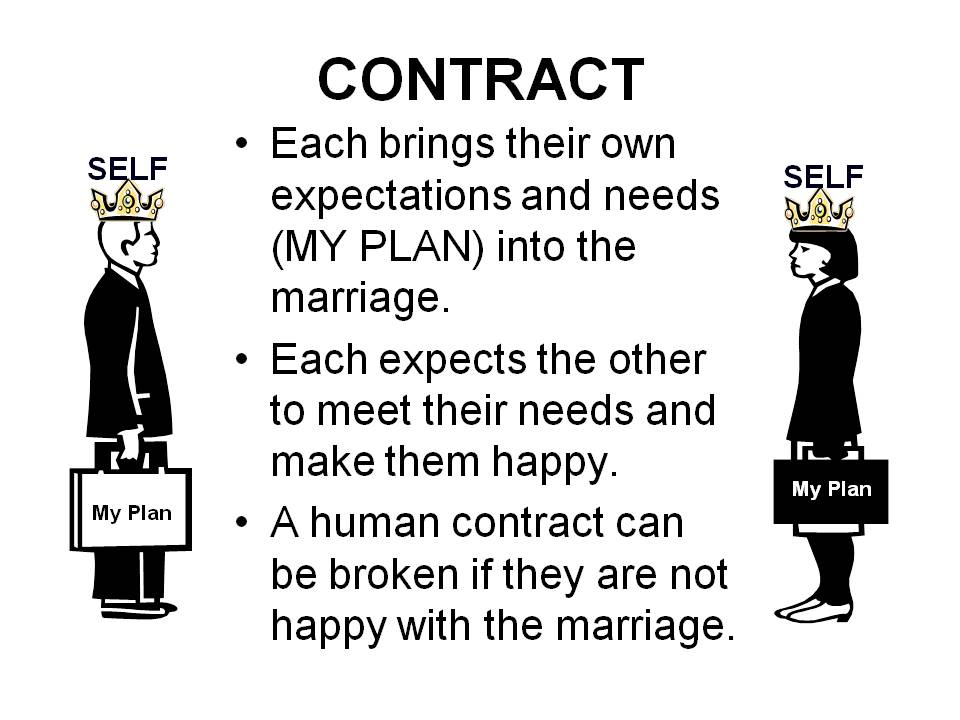 The Contract
In both of these secular models, the legal agreement is a contract between two people that can be broken or nullified at any time—that is, if they are unsatisfied with the way the “house” turns out or if either of them decides to build a better house with someone else.
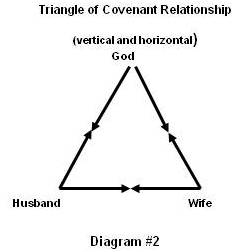 According to the Biblical Model, God is the Architect. The Christian couple who chooses to build a biblical marriage will diligently follow God’s Word as their blueprint. The husband and wife are the builders—equal partners—in the building process. Rather than entering into a legal contract between two people, they enter into a covenant with each other and God forming a “Triangle of Covenant Relationship” (Diagram #2), which is both a vertical and horizontal relationship.
Derek Prince, in his book The Marriage Covenant, described the relationship as follows:
“…marriage as it was conceived at creation, is a binding together of three persons: a man, a woman and God. When God is added to the relationship, it introduces a new dimension. God becomes an integral part of the marriage” (1978, 24).
 AUTHORITY IN MARRIAGE
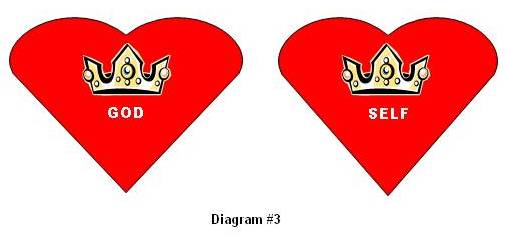
Once the house is ready for occupancy, the couple will have to make an important decision: Who will be “in charge” in their marriage? In other words, who will be given the place of “authority”? They only have two options: the boss will either be “God” or “Self” (Diagram #3).
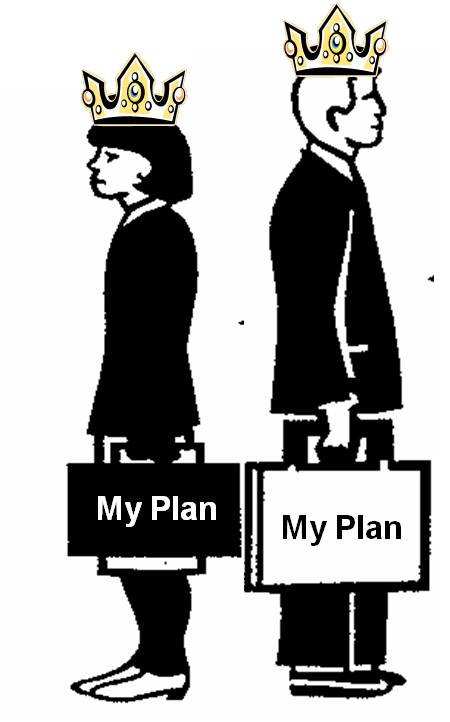 If the husband and wife place their own interests, desires and needs first, then “Self” will be enthroned as the authority in each of their hearts. Their marriage will quickly become a battlefield where two selfish people lock horns in a battle of the wills. When the storms of life shake such a marriage, the superficial love that initially brought them together usually dwindles and may die completely.
 If they choose to obey Christ’s commandment to love and serve one another (Gal. 5:13-26; Phil. 2:1-5) and give up their right to control the other, they have placed God in the position of authority in the marriage. Marriage cannot be understood apart from our obedience to Christ’s command to do nothing out of selfishness but with humility of mind put another person’s interests ahead of our own.
Jeffrey and Pattiejean Brown in their book, The Total Marriage, in the section entitled “It Takes Two to Submit” describe how authority operates within a biblical marriage:
I believe that when people of the world look at a Christian home they have a right to see something different. A man and a woman not striving to be the boss. Instead, they’re striving to outdo one another in love. Nobody imposes his or her will on the other anymore. Nobody gives in just for the sake of peace. They seek God together. They develop together. They grow together. Christian marriage has been defined as a union of loving service to others (1999, 56-58).
POWER STRUCTURE IN MARRIAGE
Finally, the couple will have to determine what their roles and responsibilities will be in the marriage. This is what we call the power structure. In his video series, Building Families that Last, Dr. Richard Dobbins explained the importance of couples determining their power structure in marriage:
Role conflict and power struggles are some of the most threatening problems facing couples in marriage. Christians are not immune from the role changes that are taking place in our society today. Very few couples have the foresight to discuss the power structure of their relationship before they marry. What role and responsibilities will the husband fulfill in the marriage and family? And what will the wife’s role and responsibilities include? Mutually determining the power structure of the marriage will eliminate much lost and wasted energy in competing for leadership later on. The couple needs to agree on the power structure of their relationship, for families that achieve purpose are built on powerful marriages.
Power Structure Models
In Her book, To Have and to Hold, Nancy Van Pelt described five different role models in marriage: Patriarchal, Matriarchal, Co-leadership, Power Struggle, and Supportive Leadership. Van Pelt used the term Role Patterns, which is what Dobbins referred to as power structure. We will look at three of these models as they apply to the models being discussed in this reading:
Patriarchal. The model of choice for the Traditional African Secular marriage: “Husbands rule and wives obey!” is the motto of this marriage.
In this relationship the husband’s leadership is unquestioned. His word is law. He determines all policies and rules for the entire family. The patriarchal leader may or may not choose to consult with family members, depending upon his degree of authoritarianism (1980, 120).
Power Struggle. This is the popular model for the Modern Western Secular marriage; “Every man for himself!” and “May the best man win!” describe this marriage.
In this pattern both husband and wife compete for the leadership role. He fights against her when she attempts to make a decision, and she counters with methods of usurping his authority. The contestants have never clarified their rules, and authority in the family shifts from one partner to the other, depending on who wins the last battle (1980, 120).
Supportive Leadership. The Supportive Leadership Model is what makes the Biblical Model of marriage so unique and different from all the rest and gives marriage the power to withstand the storms of life. The motto for the biblical marriage is “I no longer live for myself, I live for you.”
It is based on the Christian concept of mutual submission as a way of life in all interpersonal relationships. In a supportive relationship both partners willingly give up absolute power to dictate and control. Neither demands that his or her way is the only way and insists on unquestioned obedience. Rather, each shows a readiness to negotiate and adjust differences until common ground is established (1980, 122).
Jeffrey and Pattijean Brown in the section entitled, “It Takes Two to Submit,” also gave their definition of mutual submission, which Paul wrote about in Ephesians 5:21.
This is what it says: ‘Submitting yourselves one to another in the fear of God’ (Eph. 5:21). Paul is stressing the idea of mutual submission. Mutual submission requires that Christians, regardless of status, function, sex, or rank, ‘through love be servants [literally “slaves”] of one another’ (Gal. 5:13). If a partner is to submit as Christ’s Church is to submit, then the biblical definition of submission is a free response and uncoerced surrender to the self-sacrificing, unconditional love of a compassionate mate and committed spouse. Mutual submission is Christian and it’s a beautiful thing (1999, 56).
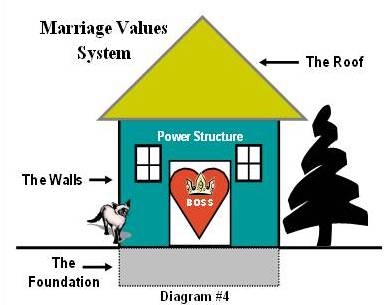 BUILDING A HOUSE
A good builder always begins with a solid foundation, followed by the construction of the walls, and then the roof. In this article we will show how all of these aspects of building a house apply to building a marriage (Diagram #4).
Traditional African Secular Model
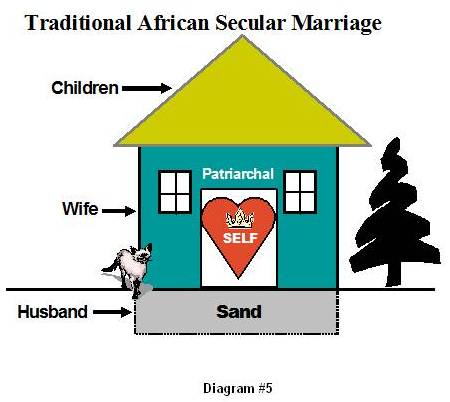 The Foundation. According to this model, the husband is the foundation making him the most important part of the structure and upon which everything else is built. The marriage finds its origin, strength and purpose through the husband (Diagram #5).
The Walls. The wife’s place in the marriage can be compared to the walls of the house. Her role is to hold the family together through serving her husband and children and making their lives comfortable and happy. Her main purpose is to bear children for her husband (which also includes his clan /extended family)—they are his progeny, or his on-going spirit. She is to serve him and obey him in every way to establish his happiness and fulfill his purpose in life.
The Roof. In this model the children are as important to the marriage as the roof is to the house. This illustrates the importance placed on children in the traditional marriage. In other words, a house without children would be as foolish or useless as a house without a roof.
Modern Western Secular Model
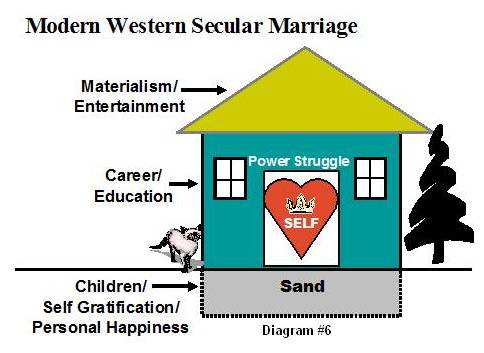 The Foundation. As illustrated in Diagram #6, according to this model, self-gratification and personal happiness rise to the top of the list of expectations for marriage. Many people think that getting married will be their answer to personal happiness! Too often however, within months, if not days, of saying “I do,” the husband and wife become disillusioned with the marriage when their spouse fails to meet all their needs and make them “happy.” In some marriages children become the foundation when the couple attempts to find their fulfillment and purpose through their children.
The Walls. In this model, the couple’s emphasis on education, career and success are like the walls of a house. If the marriage is being sustained by these materialistic values, then failure to achieve these goals will put a strain on the relationship. If getting ahead in this world is their primary objective, such success-driven couples will become disillusioned with marriage when these objectives are not achieved.
The Roof. According to the Modern Western Secular Model of marriage, materialism and entertainment are like the roof, which is the most prominent part of the house. Couples place a great amount of emphasis on their material possessions and “toys”—houses, cars, computers, clothes, jewelry, etc. These “things” become symbols of marital success and prosperity. The entertainment industry has capitalized on the modern-day trend and drive for fun and enjoyment. Many couples will go into financial debt in order to enjoy superficial and materialistic pleasures, which places an additional strain on an already shaky foundation.
“The winds blew and beat against that house!” (Matt. 7: 27)
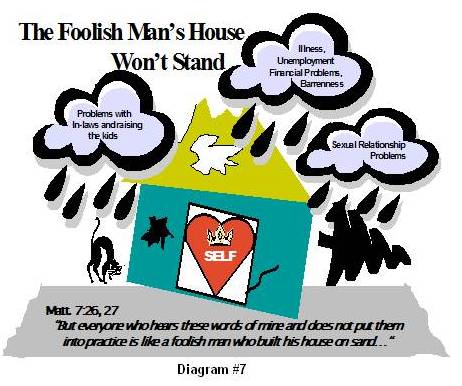 What happens to a marriage that is built on sand when it is subjected to the storms and problems of life? Problems with in-laws and extended families, with children, illness, financial struggles, the death of a loved one, loss of employment, barrenness, couples who have problems with their sexual relationship and sadly, even unfaithfulness, just to name a few? These things ultimately take all the joy and fulfillment out of the marriage that is built upon any foundation other than the principles of God’s Word. Any other approach to marriage is like building a house upon “sand” and when it falls, it makes a “great crash!” (Diagram #7)
The Biblical Model
The Foundation. The foundation of a Christian marriage is the solid Rock of God’s Word. Everything a couple needs to know about building a successful biblical marriage is summarized in Genesis 2:24, 25: “Therefore shall a man leave his father and his mother, and shall cleave to his wife: and they shall become one flesh. And the husband and wife were both naked and were not ashamed.” In his book, Strike the Original Match, Charles Swindoll wrote that this scripture passage establishes the biblical foundation for marriage. He outlined four foundational principles that are necessary for building upon the Rock: leaving (severance); cleaving (permanence); becoming one flesh (unity); being naked and not ashamed (intimacy).
Foundational Principle of Severance. The first thing God said to the man and woman when he pronounced them man and wife was that the man must “leave” his father and mother, which Swindoll refers to as the foundational principle of severance:
In order for the new relationship between bride and groom to flourish and their home to begin correctly, the cord must be cut with the parents. This does not mean abandoning our parents or ignoring or mistreating or cutting off all contact with them. To “leave father and mother” means to break the parent-child bond, to sever the tight, emotionally dependent strings that once provided security, protection, financial assistance, and physical needs. All or any of those ties, if brought over into a marriage, will hinder the bond of marriage from sealing” (1981, 29).
In his book, I Married You, Walter Trobisch said this about “leaving”:
There can be no marriage without leaving. The word “leaving” indicates that a public and legal act has to take place in order to make marriage a marriage…If no real leaving takes place, the marriage will be in trouble. If the young couple have no chance to start their own home, completely separate from their families, the danger is great that the in-laws will interfere continuously (1971, 12-13).
Foundational Principle of Permanence. The second foundational principle outlined in Genesis 2: 24, 25 is “cleave.” This word in Hebrew literally means to be “glued together.” Swindoll calls this the foundational principle of permanence:
In order for a marriage to survive…each couple needs to view the commitment to each other as an irrevocable, permanent bond…Leave and cleave. Sever and bond. Loosen and secure. Depart from and attach to. The Hebrew term translated “cleave” means “to glue, to cling.” Today’s problem is largely explained by the fact that couples enter marriage believing it is terminable. “Till death do us part” is, unfortunately, a mere verbal formality to many who utter those words (1981, 30).
Trobisch expanded the meaning of “cleave” to include “love:”
Perhaps we would use another word today in place of “to cleave.” We would no doubt use the word “to love.”… Cleaving means love, but love of a special kind. It is love which has made a decision and which is no longer a groping and seeking love. Love which cleaves is mature love, love which has decided to remain faithful—faithful to one person—and to share with this one person one’s whole life (1971, 16-17).
Foundational Principle of Unity. Charles Swindol refers to “one flesh” as the foundational principle of unity:
Becoming one flesh suggests a process, not an instant fact. Two people with different backgrounds, temperaments, habits, scars, feelings, parents, educational pursuits, gifts, and interests don’t immediately leave a wedding ceremony in perfect unity. It is a lifelong project requiring wisdom, understanding, and knowledge…The whole idea of mutual acceptance, giving, listening, forgiving, belonging, and direction was implied. It is two individuals willingly blending into each other’s lives, desiring to share with and thereby complete the other… “One Flesh” also has to do with the physical aspect of marriage. The sexual aspect of marriage is essential to the marriage as much as the leaving and cleaving. The success of the sexual relationship between husband and wife is directly proportionate to the success of the other areas of intimacy in marriage—emotional, spiritual, intellectual, and social (1981, 31-32).
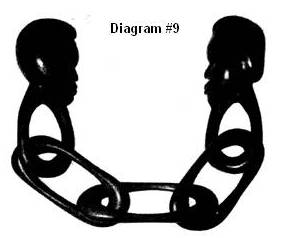 Trobisch used a wooden carving to illustrate the concept of “one flesh” (Diagram #9):
This expression describes the physical aspect of marriage…The physical union of husband and wife is as dear and as near to God as is their faithfulness and the legality of their marriage…I reached down into my briefcase and brought out a carving of two heads—the one of a man and the other of a woman. The heads were connected by a chain with wooden links…This is a marriage symbol which the church in Liberia gives to the young couple as a reminder of their marriage vows. If you came close and inspected it carefully, you would see that this chain has no joint. The whole piece of art is carved out of one piece of wood and conveys the message: “Where God joins, there is no joint” (1971, 17-19).
Foundational Principle of Intimacy. Genesis 2:25 says, “And the man and his wife were both naked and were not ashamed.” Swindoll refers to “naked and not ashamed” as the foundational principle of intimacy:
The Hebrew term translated “naked” suggests the idea “laid bare,” emphasizing totally and completely naked. When the verse adds that Adam and Eve “were not ashamed,” the idea from the original construction is reciprocal…they had no hidden areas, no hang-ups, no embarrassment, no fears. There was total transparency, the complete absence of self-consciousness. This gave them unrestrained freedom. Emotionally as well as physically. Inwardly and outwardly (1991, 33-34).
South African author, Costa Mitchell, in his book, Intimacy in Marriage said this:
God intended intimacy to characterize marriage. The verb “to know” is used in the Bible to describe the sexual consummation of this relationship. Genesis 4:1 “Adam knew Eve his wife, and she conceived…”Intimacy is not just sexual consummation. It encompasses a totality of knowing that includes understanding how my partner thinks, and sharing the dreams and goals she is pursuing, her values and feelings, what makes her happy or sad, feel loved and valued. Most importantly, intimacy is manifested when I cooperate with my partner, sharing her ambitions and fostering the sense that she is cherished and held in high regard. Sexual union that reflects this emotional and psychological oneness is the true intimacy God designed for marriage (1990, 21, 22).
The Walls. A house is only as strong as the walls that support it. Swindoll also said, “God says we need only three essential ingredients to restore our marriage and make it flourish again” (1981, 24). These ingredients are found in Proverbs 24:3, 4 which says: “By wisdom a house is built, and by understanding it is established; and by knowledge the rooms are filled with all precious and pleasant riches.” Wisdom, understanding and knowledge are the three vital ingredients needed to construct the walls of the “house”. In order to build a strong marriage, we must use these quality materials:
Knowledge. Couples need to acquire knowledge in order to build their house God’s way. First, they must seek knowledge of God’s Word which teaches His view of marriage. In the same way that a builder studies the blueprint for the house he is building, couples need to consult God’s blueprint for marriage. Only a foolish builder would attempt to build a house without studying the plans thoroughly and referring to them continuously during the process. Hosea 4:6 says, “My people are destroyed for lack of knowledge.” How often we attempt to build our marriages without this vital knowledge and then wonder why they are falling apart. A lack of knowledge can destroy a marriage, but the abundance of knowledge fills the house with precious riches.
Secondly, husbands and wives need practical knowledge, such as understanding the basic differences between men and women for starters. Then we need to understand that every person is a unique creation having different views about every aspect of life. There are also vast differences in communication styles and methods of resolving conflict. Each person has a unique background and family history which shapes them into how they approach relationships and intimacy. Having this knowledge is essential when it comes to building a strong marriage. Dr. Richard Dobbins said husbands and wives need to make their mate the focus of on-going life study and in-depth research. Practical knowledge will enable a husband and wife to truly love each other with God’s unconditional love.
Understanding. Another vital ingredient in a successful marriage is understanding. How can we begin to meet another person’s needs when we do not understand them? Because God created male and female so different, we need to broaden our understanding and begin to see life through the eyes of our spouse. A strong marriage exists when a husband and wife strive to understand his or her partner’s needs and then make a conscious effort to meet them.
Wisdom. Another important ingredient in marriage is wisdom. Swindoll said that wisdom is: “seeing with discernment. It’s having a broad perspective. The term stresses accuracy, the ability to sense that which is beneath the surface” (1981, 24). Wisdom is evident when experience, knowledge and understanding are applied with discretion, practicality and common sense. The most effective means of gaining wisdom is through acquiring knowledge and understanding of others through communication. Therefore, a strong marriage is characterized by a couple’s ability to communicate effectively and resolve conflict appropriately and promptly. A lack of wisdom gained through communication would be like building a house with inferior materials.
The Roof. Instead of the roof representing children or cultural values, it now serves as a testimony of God’s supernatural and unconditional love (agape). It is the self-sacrificial, servant love that puts the emphasis on serving others rather than oneself. In a biblical marriage where Christ’s law of love is demonstrated, the roof openly symbolizes a powerful testimony of God’s love. The demonstration of agape love and godly principles between a husband and a wife is a testimony to the world of who we are as followers of Christ. John 13:35 says, “By this all men will know that you are My disciples, if you have love [agape] for one another.” The primary relationship between a Christian husband and wife is that they are a brother and sister in the Lord. This places the entire marital relationship on a much higher plane than a secular marriage.
CHILDREN ARE A “BLESSING”
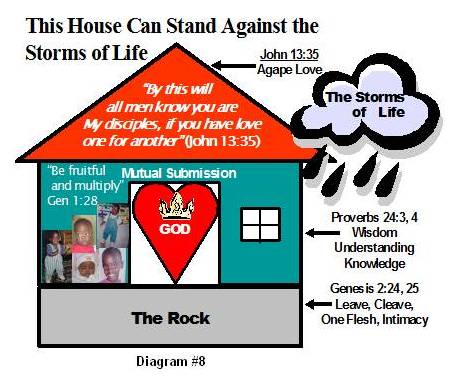 How do children fit into the Biblical Model of marriage? Genesis 1:28a states, “And God blessed them, and God said to them, ‘Be fruitful and multiply, and fill the earth…’” Children are given to couples as a blessing and are neither a requirement nor the sole purpose for marriage. In Diagram #8, we see that children are not part of the “structure,” which includes the foundation, the walls, and the roof. Rather, they are given to the couple so that they may be nurtured in the wholesome environment of a Christian family. This is where they will be sheltered and cared for and where they will receive the love and acceptance of godly parents. This is also where they will receive instruction and training for godly living.
Proverbs 22:6 instructs parents to “train up a child in the way he should go, and even when he is old, he will not depart from it.” A child who is raised with biblical values will become a vessel for service in God’s kingdom and also become a tremendous blessing to the parents and family: “A wise son brings joy to his father” (Prov. 15:20). Nothing brings greater joy to a parent’s heart than a child who loves God and walks in His ways, but if we disregard the guidelines that God has given to us as parents, we will likely reap a harvest of grief and bitterness instead of joy: “A foolish son brings grief to his father and bitterness to the one who bore him” (Prov. 17:25).
What About the Childless Marriage?
What about couples who are unable to have children? For a variety of reasons, some people cannot have children; various physical and psychological conditions can affect a couple’s fertility. God has a purpose for every marriage—regardless of whether they produce children or not. Christians have been given the promise that, “God causes all things to work together for good to those who love God, to those who are called according to His purpose” (Rom. 8:28). Even a childless couple can have a complete, fulfilling marriage—one that brings glory to God by manifesting His agape love. If we truly believe that God is able to work all things together for good, we must also believe that God can use even barrenness for good. In a later reading, we will discuss the matter of adoption. Adoption is a viable option available for a childless couple who really desires to have children.
GOD’S COMMAND TO “SUBDUE” AND “RULE”
After God pronounced His blessing upon Adam and Eve, He also gave them a command in Genesis 1:28b. He told them to “subdue [the earth] and rule over the fish of the sea, and over the birds of the sky, and over every living creature that moves upon the earth.” Together, Adam and Eve received this command which established the perspective that a biblically-based marriage is one that empowers people to make an impact in the world where they live. When God told Adam and Eve that they were to subdue and rule, He established a biblical model for marriage. Couples, therefore need to understand that their marriage is not without purpose but that it is established through their relationship with each other and God. Every couple should serve God in unity and cooperation, loving each other unconditionally—with intensity and passion—and combining their gifts and talents in order to bring glory to God through fulfilling His purpose for their marriage.
IN CONCLUSION
We have examined the differences between the Biblical Model and the two secular models of marriage and have discovered that what makes a marriage biblical has nothing to do with their cultural differences. What makes the difference is the values system the couple chooses to live by. The biblical marriage is governed by the law of Agape love and a Christ-like attitude and heart and stands in stark contrast to marriage based upon the world’s values of self-centeredness and personal happiness. We therefore conclude that marriages from every culture, whether African traditional or modern Western, can be biblical if they follow God’s blueprint for marriage.
God calls His people to a life of servanthood—a life in which people willingly sacrifice for the sake of others. The essential difference between a biblical and secular marriage is based on the central question: Who has the authority in the marriage? If God is the ultimate authority in the marriage it will be governed by His law of mutual love and submission (Ephesians 5:21). Therefore, any marriage regardless of the cultural context and background, will be God-honoring and fulfilling for the couple.
Jesus was speaking to Christians in His Sermon on the Mount when he used the parable about building a house. He was warning the believers what would happen it they heard His words and did not act upon them. Ask yourselves this question: Are we building our marriage upon sand or upon the Rock? The end result will be the same whether the couple is saved or not.
Bibliography:
- Brown, Jeffrey and Pattiejean, The Total Marriage, Autumn House Publishing, Granthan, England, 1999.
- Dobbins, Richard, Building Families that Last (Leader’s Guide for video series), Emerge Ministries, Akron, OH.
- Mitchell, Costa, A Practical Guide to Intimacy in Marriage, Vineyard International Publishing, Cape Town, SA, 1990.
- Prince, Derek, Marriage is a Covenant, Whitaker House, New Kensington, PA, 1978.
- Swindoll, Charles, Strike the Original Match, Multnomah Press, Portland, OR, 1981.
- Trobisch, Walter, I Married You, Harper and Row Publishers, San Francisco, CA, 1971.
- Van Pelt, Nancy L., To Have and to Hold, Southern Publishing Association, Nashville, TN, 1987.
 judyhayburn